Similes help us paint pictures with words. Instead of just saying someone is angry, a simile shows how angry they feel. That’s what makes writing fun and powerful.
In this guide, you’ll explore angry similes that are easy to understand and easy to use. Whether you’re a student, a storyteller, or just love words, these examples will help your writing feel more real and alive.
What Is a Simile?
A simile compares two things using the words “like” or “as.”
It helps readers imagine feelings, actions, or ideas more clearly.
Similes make writing colorful and easy to picture.
Full List of Angry Similes (19)
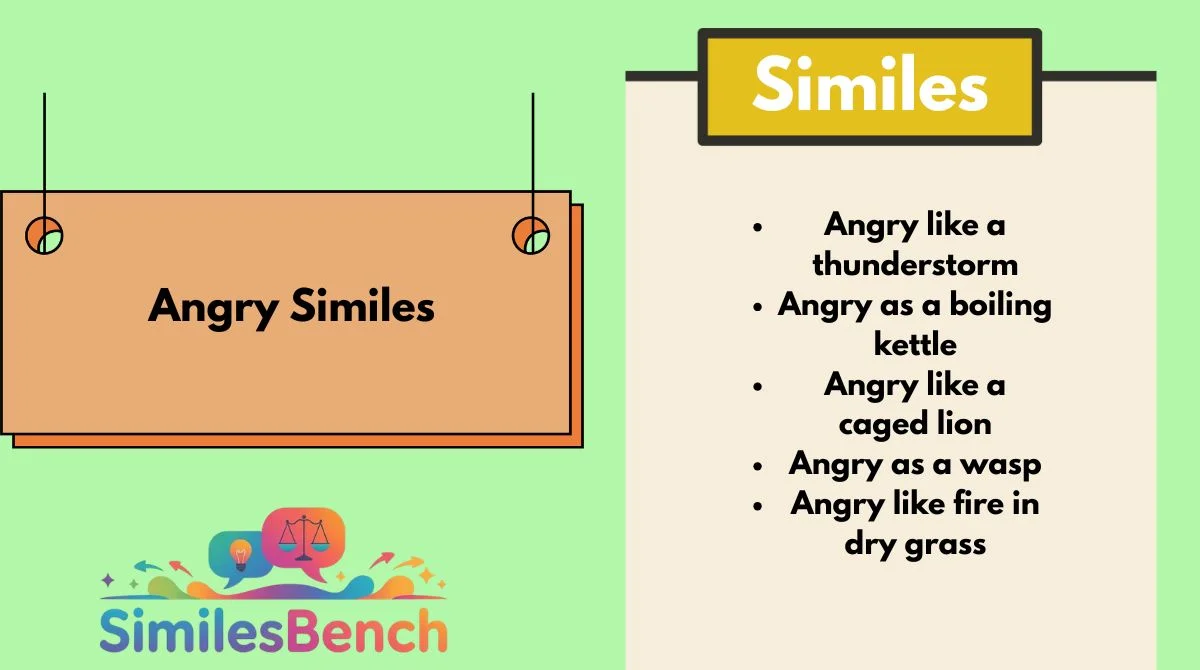
- Angry like a thunderstorm
- Angry as a boiling kettle
- Angry like a caged lion
- Angry as a wasp
- Angry like fire in dry grass
- Angry as a volcano ready to erupt
- Angry like a stormy sea
- Angry as a snapped twig
- Angry like a barking dog
- Angry as a shaken soda can
- Angry like a bull seeing red
- Angry as a cracked mirror
- Angry like lightning in the sky
- Angry as a rattlesnake
- Angry like a burning fuse
- Angry as a slammed door
- Angry like a growling bear
- Angry as a dark cloud overhead
- Angry like a clenched fist
1. Angry like a thunderstorm
Meaning: Loud, intense anger that fills the space.
Explanation: This simile shows anger that comes with noise and force.
The teacher’s voice was angry like a thunderstorm during the argument.
His words rolled out angry like a thunderstorm shaking the room.
2. Angry as a boiling kettle
Meaning: Anger that keeps building and building.
Explanation: Just like water heating up, this anger rises slowly.
She felt angry as a boiling kettle while waiting for an apology.
The room grew tense as he stood there, angry as a boiling kettle.
3. Angry like a caged lion
Meaning: Trapped anger that wants to burst free.
Explanation: This simile fits when someone feels stuck but furious.
He paced the hallway, angry like a caged lion.
Her eyes flashed, angry like a caged lion ready to roar.
4. Angry as a wasp
Meaning: Sharp, quick anger.
Explanation: This shows sudden irritation that can sting.
She snapped back, angry as a wasp.
His tone turned angry as a wasp when teased.
5. Angry like fire in dry grass
Meaning: Anger that spreads fast.
Explanation: Once it starts, it’s hard to stop.
The rumor made her angry like fire in dry grass.
His temper raced through him, angry like fire in dry grass.
6. Angry as a volcano ready to erupt
Meaning: Deep anger about to explode.
Explanation: This simile fits bottled-up emotions.
He stayed quiet, angry as a volcano ready to erupt.
Her calm face hid feelings angry as a volcano ready to erupt.
7. Angry like a stormy sea
Meaning: Wild, restless anger.
Explanation: This anger comes in waves.
Her thoughts crashed, angry like a stormy sea.
The crowd grew angry like a stormy sea after the delay.
8. Angry as a snapped twig
Meaning: Sudden anger caused by a small thing.
Explanation: One tiny moment causes a break.
He turned angry as a snapped twig over one rude comment.
She reacted angry as a snapped twig when ignored.
9. Angry like a barking dog
Meaning: Loud, showy anger.
Explanation: This simile fits yelling or complaining.
He complained angry like a barking dog.
The man shouted angry like a barking dog at the referee.
10. Angry as a shaken soda can
Meaning: Pressured anger ready to burst.
Explanation: One more shake, and it explodes.
She stayed silent, angry as a shaken soda can.
His smile hid feelings angry as a shaken soda can.
11. Angry like a bull seeing red
Meaning: Blind, intense anger.
Explanation: This simile shows loss of control.
He charged into the argument angry like a bull seeing red.
She rushed forward, angry like a bull seeing red.
12. Angry as a cracked mirror
Meaning: Anger mixed with hurt.
Explanation: This simile shows emotional damage.
Her voice sounded angry as a cracked mirror.
He laughed bitterly, angry as a cracked mirror inside.
13. Angry like lightning in the sky
Meaning: Fast and powerful anger.
Explanation: It strikes suddenly and hard.
His reply came angry like lightning in the sky.
She glared angry like lightning in the sky.
14. Angry as a rattlesnake
Meaning: Dangerous anger with warning signs.
Explanation: You can feel the threat.
He spoke softly but angry as a rattlesnake.
Her stare turned angry as a rattlesnake ready to strike.
15. Angry like a burning fuse
Meaning: Anger leading to an explosion.
Explanation: Time is running out.
His patience burned angry like a burning fuse.
She waited, angry like a burning fuse counting down.
16. Angry as a slammed door
Meaning: Sudden, final anger.
Explanation: This simile shows strong emotion without words.
She walked away angry as a slammed door.
The silence felt angry as a slammed door.
17. Angry like a growling bear
Meaning: Deep, threatening anger.
Explanation: It warns others to stay back.
He stood firm, angry like a growling bear.
Her low voice sounded angry like a growling bear.
18. Angry as a dark cloud overhead
Meaning: Heavy, lasting anger.
Explanation: It hangs and affects everything.
The room felt angry as a dark cloud overhead.
His mood stayed angry as a dark cloud overhead all day.
19. Angry like a clenched fist
Meaning: Tight, controlled anger.
Explanation: This anger is held inside.
She listened quietly, angry like a clenched fist.
His jaw tightened, angry like a clenched fist.
Creative Writing Tips
Similes are tools, not decorations. Use them where emotions matter most.
In stories:
Pick similes that match the scene. A quiet argument needs a softer image than a shouting match.
In poems:
Short similes work best. One strong image can carry a whole feeling.
In essays:
Use similes to explain emotions or reactions, but don’t overdo them. One good simile is enough.
In songs:
Choose similes that sound natural when spoken aloud. Rhythm matters here.
Helpful tip:
Ask yourself, “What does this anger feel like?” Then choose a simile that fits that feeling, not just the word “angry.”
FAQs
What are angry similes?
Angry similes compare anger to something else using “like” or “as” to make feelings clearer.
Why should students use similes?
Similes make writing more interesting and help readers understand emotions better.
Can similes be used in school essays?
Yes. When used carefully, similes can improve explanations and descriptions.
Are similes only for stories and poems?
No. They work in essays, songs, speeches, and even daily writing.
How do I create my own simile?
Think about the feeling, then compare it to something familiar that matches it.
Conclusion
Angry similes turn simple emotions into clear pictures. They help readers feel what the writer feels. By using the right simile at the right moment, your writing becomes stronger and more memorable.
Practice using these examples, then try creating your own. With time, similes will feel natural, and your words will carry real emotion.