The phrase “FOB” is commonly used in casual conversations, social media, and even dating apps—but many people aren’t entirely sure what it means or how it should be used. That uncertainty is exactly why the term gets searched so often. Some hear it used jokingly among friends, while others encounter it in a more serious or even offensive context.
Understanding slang like this is important because meanings can shift depending on tone, culture, and situation. What might seem harmless in one setting could be misunderstood in another. That’s why learning the deeper context behind such terms helps avoid confusion and miscommunication.
In this article, you’ll discover the full meaning of “FOB,” where it came from, how people use it today, and when it’s appropriate—or inappropriate—to say it. Whether you’re curious, confused, or just want to stay informed, this guide breaks everything down in a simple and clear way.
Definition & Meaning
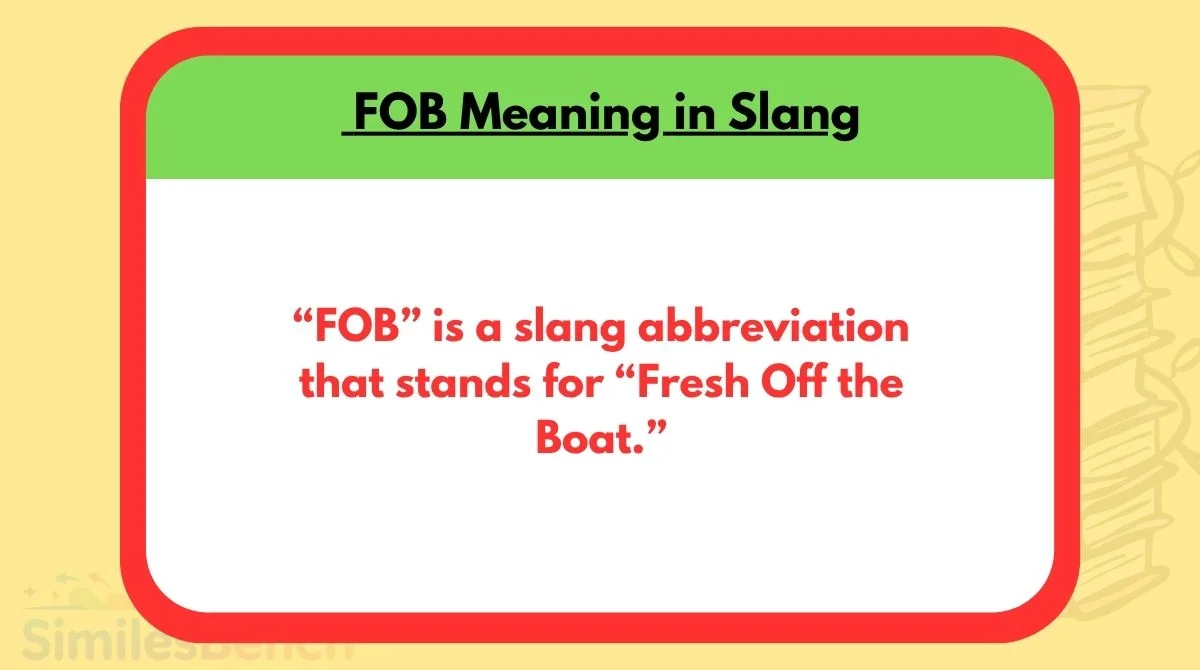
“FOB” is a slang abbreviation that stands for “Fresh Off the Boat.” It is typically used to describe someone who has recently immigrated to a new country and is still strongly connected to their original culture, language, or habits.
In everyday usage, the term often refers to individuals who may have noticeable accents, wear traditional clothing, or behave in ways that reflect their home country rather than the local culture. Depending on context, it can be used either neutrally, humorously, or negatively.
For example:
- Neutral: Referring to someone who just arrived in a new country
- Casual/joking: Friends teasing each other about cultural habits
- Negative: Used to stereotype or insult someone
Because of these varying tones, the meaning of “FOB” is not fixed—it depends heavily on intent and delivery. In some communities, people even reclaim the term and use it proudly to express their identity.
Background & History
The phrase “Fresh Off the Boat” originally comes from historical immigration periods when people traveled by ship to settle in new lands. When immigrants arrived, they were literally “fresh off the boat,” meaning they had just stepped into a new country.
Over time, the phrase evolved into a slang abbreviation—“FOB.” It gained popularity in countries with large immigrant populations, such as the United States, Canada, and the United Kingdom.
Initially, the term was often used in a negative or dismissive way to label newcomers as outsiders who hadn’t yet adapted to local customs. However, as cultures blended and younger generations grew up balancing multiple identities, the meaning began to shift.
In modern times, especially among younger people, “FOB” can be used more playfully or even embraced as a badge of cultural pride. Social media and pop culture have played a big role in reshaping its tone, making it less strictly offensive in some contexts—but not entirely harmless.
Usage in Various Contexts
The way “FOB” is used can vary widely depending on the situation. In casual conversations, especially among friends from similar cultural backgrounds, it might be used jokingly without harmful intent. For instance, someone might say, “That’s so FOB,” to describe traditional habits or preferences.
In contrast, when used by outsiders or in unfamiliar groups, the term can come across as insensitive or offensive. It may imply that someone doesn’t belong or isn’t “modern enough,” which can lead to discomfort or conflict.
Online, the term appears in memes, videos, and discussions about cultural identity. In these spaces, it is often used humorously but still carries undertones that can be misunderstood.
In professional or formal environments, the term is rarely appropriate. Using it in such settings could be seen as disrespectful or discriminatory.
Common Misconceptions & Clarifications
One major misconception is that “FOB” always means something offensive. While it can be offensive, that’s not always the case. In some communities, people use it lightly or even affectionately.
Another misunderstanding is that it only applies to immigrants from specific regions. In reality, the term can refer to anyone who is newly arrived in a different country, regardless of background.
Some also assume it strictly refers to behavior, but it can also relate to language, fashion, or cultural practices.
The key clarification is this: the meaning depends on context, tone, and relationship between people.
Similar Terms & Alternatives
There are several terms that are sometimes used in similar ways, though each has its own nuance. Words like “newcomer,” “immigrant,” or “expat” are more neutral and widely accepted.
In slang, phrases like “just arrived” or “new here” can replace “FOB” without any negative implications. These alternatives are safer choices, especially in mixed or professional settings.
Choosing respectful language helps avoid misunderstandings and keeps communication inclusive.
How to Respond to This Term
If someone uses the term “FOB” around you, your response can depend on how it’s used. If it’s clearly meant as a joke among friends, you might simply laugh it off or engage casually.
However, if it feels uncomfortable or disrespectful, it’s completely valid to address it. You could say something like, “I’d prefer not to be called that,” or ask what they mean by it.
Setting boundaries politely but firmly is often the best approach. It helps others understand your perspective without escalating the situation.
Regional or Cultural Differences
The interpretation of “FOB” varies across regions and cultures. In multicultural societies, it may be more commonly understood and used, sometimes even humorously.
In other regions, the term might be unfamiliar or perceived as more offensive due to lack of context. Cultural sensitivity plays a major role in how it is received.
Among younger generations, especially online, the term is sometimes used more casually. Older generations, however, may view it as more disrespectful.
Comparison with Similar Terms
Compared to neutral terms like “immigrant” or “new arrival,” “FOB” carries more emotional and cultural weight. It often implies judgment about how someone behaves or fits into society.
Unlike professional terms, it is informal and context-dependent. This makes it less suitable for formal discussions.
While some slang terms fade over time, “FOB” continues to exist because of its connection to identity and cultural experiences.
Usage in Online Communities & Dating Apps
On social media and dating platforms, “FOB” is sometimes used in profiles, captions, or comments. Some users might include it humorously to describe themselves, while others might use it to filter preferences or express opinions.
However, this usage can be risky. It may come across as stereotyping or exclusionary, especially in diverse online spaces.
When used carefully and self-referentially, it might be acceptable. But when directed at others, it can easily be misinterpreted.
Hidden or Offensive Meanings
Although it may seem harmless in some situations, “FOB” can carry hidden negative meanings. It can imply that someone is less sophisticated, less integrated, or “different” in a negative way.
This underlying tone is what makes the term sensitive. Even when used casually, it can reinforce stereotypes or make people feel excluded.
Being aware of these hidden implications helps in using language more responsibly.
Suitability for Professional Communication
In professional settings, using slang like “FOB” is not recommended. It can be perceived as inappropriate, unprofessional, or even discriminatory.
Workplaces value respectful and inclusive communication. Using neutral and clear language ensures that everyone feels comfortable and respected.
When in doubt, it’s always better to choose formal and widely accepted terms.
FAQs
What does FOB stand for?
It means “Fresh Off the Boat.”
Is FOB offensive?
It can be, depending on tone and context.
Can FOB be used jokingly?
Yes, but only in familiar and respectful settings.
Is FOB appropriate at work?
No, it is not suitable for professional communication.
Does FOB apply to all immigrants?
It can refer to any newcomer, not a specific group.
Should I use FOB in daily conversation?
Only if you’re sure it won’t offend anyone.
Conclusion
Understanding slang like “FOB” requires more than just knowing its definition—it involves recognizing its history, context, and emotional impact. While it may be used casually or humorously in some settings, it can also carry negative or offensive undertones.
Being mindful of how and when to use such terms is essential for respectful communication. Language evolves, but empathy and awareness remain key to avoiding misunderstandings. Choosing words carefully helps create more inclusive and positive interactions in both personal and professional environments.