In today’s digital age, slang terms evolve quickly, especially in online conversations, dating apps, and social media. One such commonly searched phrase is “NSA.” Many people come across this abbreviation in chats or profiles and feel unsure about its exact meaning. While it may seem simple at first glance, “NSA” can carry different interpretations depending on the context.
People often search for this term to avoid misunderstandings, especially in sensitive situations like dating or communication with new acquaintances. Knowing what “NSA” means helps you respond appropriately and set clear expectations.
This article breaks down the meaning, origin, usage, and nuances of the term in a clear and easy-to-understand way. Whether you’ve seen it in a message or profile, this guide will help you fully understand what it implies and how to handle it confidently.
Definition & Meaning
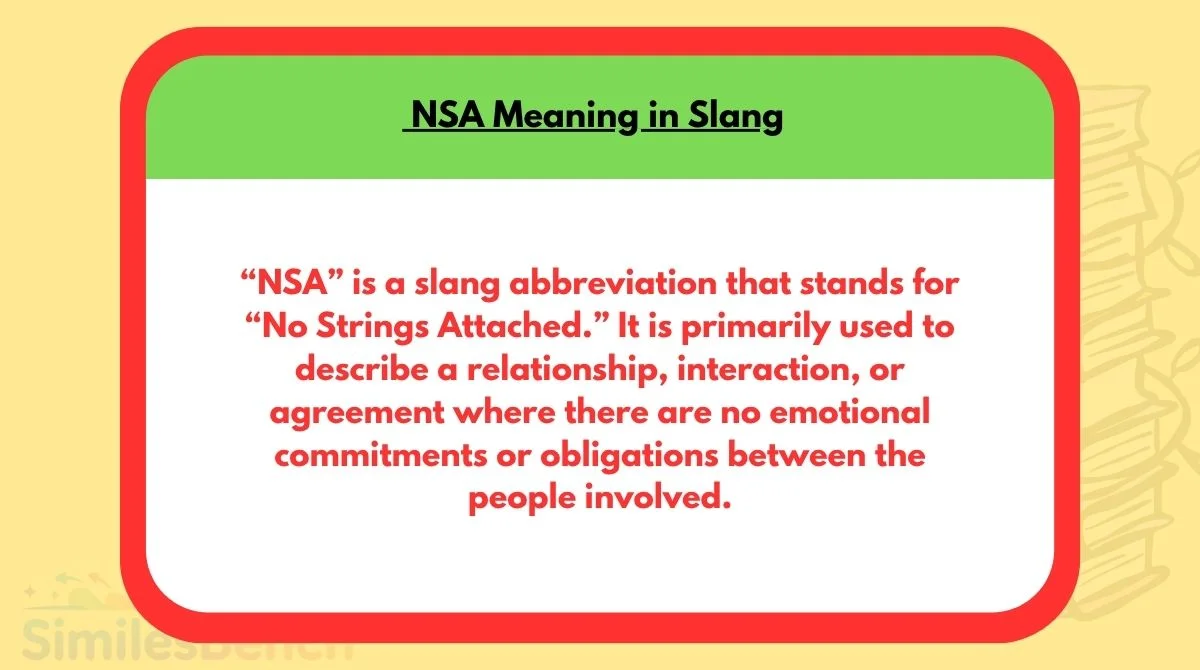
“NSA” is a slang abbreviation that stands for “No Strings Attached.” It is primarily used to describe a relationship, interaction, or agreement where there are no emotional commitments or obligations between the people involved.
In simple terms, when someone says they want something “NSA,” they mean they are looking for a casual connection without expectations like long-term commitment, exclusivity, or emotional involvement. This term is most often used in dating contexts, but it can also appear in other informal situations.
The phrase emphasizes freedom and independence. Both parties are expected to understand that the connection is temporary or purely physical, with no deeper relationship goals. It’s important to note that “NSA” does not necessarily imply anything negative—it simply reflects a preference for a specific type of interaction.
However, the meaning can vary slightly depending on tone and context. In some cases, it may suggest honesty and transparency about intentions. In others, it might come across as emotionally detached or impersonal. Understanding the intent behind its use is key to interpreting it correctly.
Background & History
The concept behind “No Strings Attached” has existed long before the abbreviation became popular. Historically, the phrase was used in general English to describe situations where no obligations were tied to an offer or agreement.
The abbreviation “NSA” gained traction with the rise of internet culture, texting, and online dating platforms. As communication became faster and more concise, people began shortening commonly used phrases into acronyms. “NSA” quickly became a convenient way to express relationship expectations without lengthy explanations.
Its popularity increased significantly with the growth of dating apps, where users often describe their preferences in a few words. Over time, it became widely understood across different platforms and communities.
Although “NSA” is now strongly associated with modern dating culture, its roots are grounded in a broader idea of freedom from commitment. The abbreviation simply made it easier to communicate that idea in a fast-paced digital world.
Usage in Various Contexts
“NSA” is most commonly used in casual conversations, especially in digital communication. Its meaning can shift slightly depending on where and how it is used.
In dating apps, “NSA” typically indicates that someone is not looking for a serious relationship. It sets expectations upfront, helping avoid confusion or mismatched intentions. This usage is straightforward and widely recognized.
In texting or chat conversations, someone might use “NSA” to clarify boundaries. For example, they may say they want to keep things light and uncomplicated. In this case, it acts as a way to define the nature of the interaction early on.
Outside of dating, the term can occasionally be used more broadly to describe any arrangement without obligations. For instance, someone might refer to a casual agreement or favor as “NSA,” meaning there are no expectations attached.
Despite its flexibility, the tone of “NSA” can vary. In friendly contexts, it may sound casual and honest. In more serious conversations, it might feel distant or emotionally detached. Understanding the situation and the relationship between the people involved is essential for interpreting its meaning correctly.
Common Misconceptions & Clarifications
One of the biggest misconceptions about “NSA” is that it always implies something inappropriate or negative. In reality, it simply describes a lack of commitment, not the nature or quality of the interaction itself.
Another misunderstanding is that “NSA” means there are no rules at all. While it suggests freedom from emotional obligations, mutual respect and clear communication are still important. Boundaries and consent remain essential in any interaction.
Some people also assume that “NSA” guarantees no emotional involvement. However, human emotions can be unpredictable. Even in casual arrangements, feelings can develop over time, which may complicate the situation.
Additionally, “NSA” is sometimes confused with official or institutional meanings of the same acronym. In slang, it strictly refers to “No Strings Attached,” and context usually makes this clear.
Understanding these misconceptions helps avoid confusion and ensures that the term is interpreted accurately.
Similar Terms & Alternatives
There are several slang terms and phrases similar to “NSA,” each with slightly different nuances.
“Casual” is one of the most common alternatives. It generally means relaxed and not serious, but it may still leave room for some emotional connection. “Hookup” is another term, often implying a short-term or physical interaction.
“Friends with benefits” (FWB) is closely related but usually involves an existing friendship combined with a physical relationship. Unlike “NSA,” it may include some level of ongoing connection.
“Situationship” is a newer term that describes an undefined or unclear relationship. It differs from “NSA” because it often involves mixed signals or uncertainty.
Each of these terms overlaps with “NSA” but carries its own subtle meaning. Choosing the right term depends on the situation and what someone wants to express.
How to Respond to This Term
When someone uses “NSA,” your response should depend on your own preferences and comfort level.
If you are open to a casual arrangement, you can acknowledge it and discuss boundaries clearly. Communication is key to ensuring both sides understand expectations.
If you are not interested in that type of interaction, it is perfectly acceptable to decline politely. Being honest about your intentions helps avoid misunderstandings later.
You can also ask for clarification if the meaning is unclear. While “NSA” is generally understood, different people may interpret it slightly differently.
The most important thing is to respond in a way that aligns with your values and comfort. Clear communication ensures that both parties are on the same page.
Regional or Cultural Differences
The understanding of “NSA” can vary across cultures and regions. In some places, casual relationships are widely accepted, making the term more common and openly used.
In more conservative cultures, the term may be less frequently used or discussed. People might avoid it or use indirect language instead. As a result, its meaning might not always be immediately understood by everyone.
Language barriers can also affect interpretation. In regions where English is not the primary language, “NSA” may be recognized mainly among younger or more internet-savvy individuals.
Cultural values and social norms play a significant role in how the term is perceived. Being aware of these differences can help prevent misunderstandings in cross-cultural communication.
Comparison with Similar Terms
While “NSA” shares similarities with other slang terms, it has a distinct emphasis on the absence of obligations.
Compared to “casual dating,” “NSA” is often more explicit about avoiding emotional involvement. Casual dating may still include some level of connection or ongoing interaction.
In contrast to “friends with benefits,” “NSA” does not require an existing friendship. It focuses purely on the absence of commitments rather than the type of relationship.
“Situationships” differ significantly because they involve uncertainty, whereas “NSA” is usually clear and intentional from the start.
These comparisons highlight how “NSA” stands out as a direct and straightforward way to communicate expectations.
Usage in Online Communities & Dating Apps
“NSA” is especially common in online communities and dating platforms. Users often include it in profiles to quickly communicate what they are looking for.
Its brevity makes it ideal for spaces where character limits apply. Instead of writing a long explanation, users can simply use the abbreviation.
In forums and chat groups, “NSA” is also used to clarify intentions before interactions begin. This helps avoid confusion and ensures transparency.
However, not everyone interprets it the same way. Some may see it as practical and honest, while others might view it as too direct. Understanding the audience and platform is important when using the term.
Hidden or Offensive Meanings
Although “NSA” is generally neutral, it can sometimes carry unintended connotations. For some people, it may feel impersonal or dismissive, especially if used without context.
In certain situations, it might be perceived as prioritizing physical interaction over emotional connection, which can be uncomfortable for some individuals.
However, it is not inherently offensive. The perception depends largely on tone, delivery, and the expectations of the people involved.
Being mindful of how and when you use the term can help avoid misunderstandings or negative reactions.
Suitability for Professional Communication
“NSA” is not suitable for professional or formal communication. It is considered informal slang and is best used in casual conversations.
In workplace or business settings, using such abbreviations can appear unprofessional or confusing. Clear and formal language is always preferred in these environments.
If you need to express a similar idea in a professional context, it is better to use complete phrases like “no obligations” or “informal arrangement,” depending on the situation.
Keeping language appropriate to the context ensures effective and respectful communication.
FAQs
What does NSA stand for in slang?
It means “No Strings Attached,” indicating no commitment.
Is NSA only used in dating?
Mostly, but it can apply to any no-obligation situation.
Does NSA mean no emotions involved?
Not always, but it suggests avoiding emotional attachment.
Is NSA considered rude?
No, but tone and context can affect how it feels.
Can NSA relationships become serious?
Yes, feelings can develop over time.
Should I use NSA in professional settings?
No, it’s informal and not suitable for work communication.
Conclusion
Understanding the slang meaning of “NSA” helps you navigate modern communication with clarity and confidence. It is a simple abbreviation with a clear message: no commitments or obligations. While commonly used in dating contexts, its meaning can extend to other informal situations as well.
The key to using or responding to “NSA” lies in communication and mutual understanding. By knowing its nuances, you can avoid confusion, set boundaries, and interact more effectively. Like many slang terms, its interpretation depends on context, tone, and cultural background. Being aware of these factors ensures that you use the term appropriately and understand it when others do.