If you spend time online—whether on social media, gaming platforms, forums, or messaging apps—you may have come across the slang term “OP.” Many people see it in comments, captions, or gaming discussions and wonder what it actually means. Because internet slang evolves quickly, terms like this can carry different meanings depending on the platform and context.
People search for the meaning of OP in slang because it appears frequently in online conversations. For example, someone might say “That weapon is OP” in a game, or comment “Ask OP for details” on a forum thread. Without understanding the context, the meaning can be confusing.
This article explains the slang meaning of OP in clear and simple language. We’ll explore its definition, history, how it’s used across different platforms, and whether it is appropriate in professional communication. By the end, you’ll understand exactly what OP means and how to respond when you see it online.
Definition & Meaning
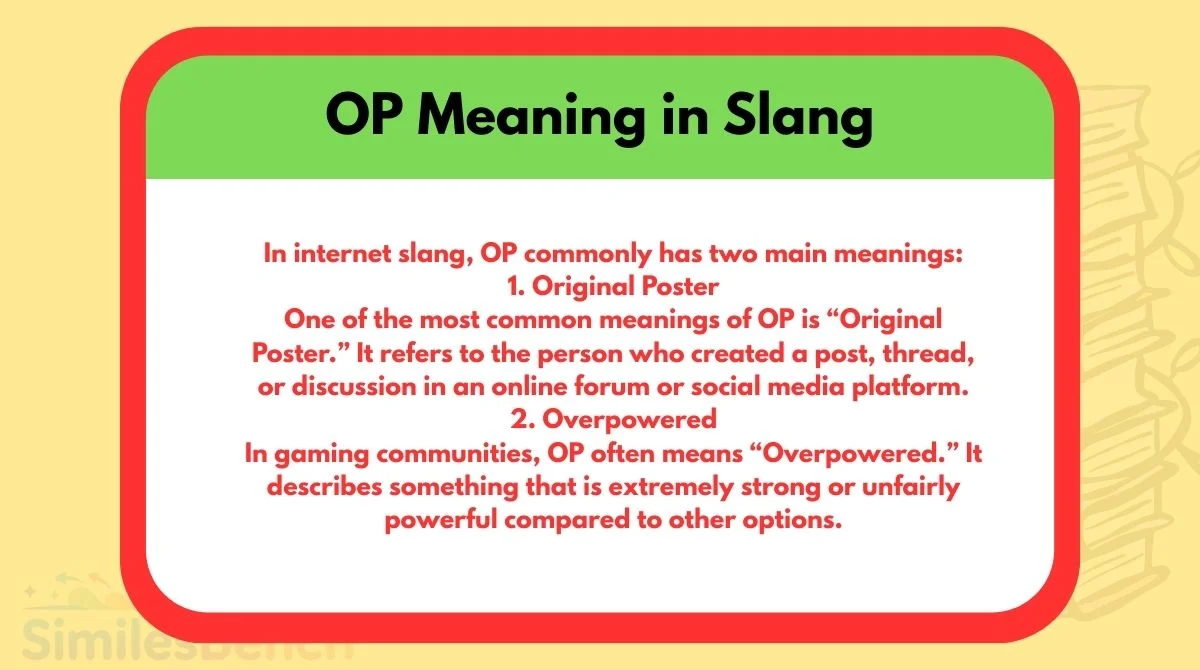
In internet slang, OP commonly has two main meanings:
1. Original Poster
One of the most common meanings of OP is “Original Poster.” It refers to the person who created a post, thread, or discussion in an online forum or social media platform.
For example:
- “OP already explained this in the comments.”
- “Ask OP for the source of the image.”
In this context, OP simply identifies the person who started the conversation.
2. Overpowered
In gaming communities, OP often means “Overpowered.” It describes something that is extremely strong or unfairly powerful compared to other options.
Examples include:
- “That character is OP.”
- “This weapon is too OP in the new update.”
Here, OP suggests that a character, tool, or strategy gives players an advantage that may disrupt game balance.
Key Point
The meaning of OP usually depends on context:
- Forums and discussions: Original Poster
- Video games: Overpowered
Understanding the environment where the term appears makes it easier to interpret its meaning correctly.
Background & History
The slang term OP developed as internet communication became faster and more informal. Abbreviations helped users type quickly and communicate efficiently in online spaces.
Origins in Online Forums
The meaning “Original Poster” emerged from early internet forums and message boards in the late 1990s and early 2000s. On platforms where discussions could grow into hundreds of replies, users needed a quick way to refer to the person who started the conversation.
Instead of typing “the person who created the thread,” users simply wrote OP.
This shorthand quickly became common on:
- Discussion forums
- Q&A websites
- Community platforms
It helped keep conversations organized and clear.
Growth in Gaming Culture
The meaning “Overpowered” became popular in gaming communities. Multiplayer games often include characters, abilities, or weapons with different strengths.
When a feature was considered too strong, players began calling it OP.
Examples:
- A weapon that defeats opponents too easily
- A character ability that gives an unfair advantage
Gamers used the term in discussions, reviews, and gameplay commentary.
Expansion into Social Media
Over time, the abbreviation spread beyond forums and games. Today, you can see OP on:
- Comment sections
- Meme pages
- Chat groups
- Video platforms
Its meaning remains largely the same, but context determines whether it refers to the original poster or something overpowered.
Usage in Various Contexts
The slang term OP appears in several types of online communication. Each environment tends to favor a specific meaning.
Social Media Platforms
On social media, OP usually refers to the Original Poster. People use it when discussing a post or responding to a comment thread.
Example:
- “OP should clarify what happened.”
- “I agree with OP.”
This allows users to refer to the person who posted content without tagging them directly.
Discussion Forums
Forums frequently use OP to keep discussions organized.
For instance, in a long conversation, someone might say:
- “OP answered this earlier.”
- “The OP updated the post.”
This helps participants follow the discussion without confusion.
Gaming Communities
In gaming conversations, OP almost always means “Overpowered.”
Players may use it to discuss game balance, strategies, or updates.
Example:
- “That character is OP after the latest patch.”
- “Developers need to nerf this weapon; it’s too OP.”
Here, OP suggests that something is excessively powerful.
Memes and Internet Humor
Memes sometimes exaggerate the idea of something being OP for comedic effect.
For example:
- “Grandma’s cooking is OP.”
- “Coffee is OP in the morning.”
This playful usage highlights how slang evolves creatively online.
Common Misconceptions & Clarifications
Because OP has multiple meanings, misunderstandings can occur.
Misconception 1: OP Always Means Overpowered
Some people assume OP always refers to gaming strength. However, in forums or comment sections it usually means Original Poster.
Misconception 2: OP Is Offensive
The term itself is not offensive. It is simply an abbreviation used for convenience.
However, tone and context matter. If someone says “This character is stupidly OP,” the comment may sound negative toward game balance rather than the player.
Misconception 3: OP Is Only Used by Gamers
Although gaming popularized the “overpowered” meaning, OP is widely used across many internet communities.
Misconception 4: OP Refers to the Most Popular Person
Some people mistakenly think OP means “most important person.” In reality, it simply refers to the person who started the post.
Clarifying these misunderstandings helps avoid confusion when reading online discussions.
Similar Terms & Alternatives
Several slang terms and abbreviations appear alongside OP in online conversations.
For Original Poster
Common alternatives include:
- Poster
- Thread creator
- Author
- Original author
However, OP remains the most common abbreviation.
For Overpowered
Other gaming terms include:
- Broken – extremely powerful or unbalanced
- Meta – the most effective strategy currently used
- Buffed – made stronger by developers
- Nerfed – reduced in strength
These terms help describe game balance and strategy.
How to Respond to This Term
Responding to OP depends on the context in which it appears.
When It Means Original Poster
If someone refers to you as OP, they are simply acknowledging that you created the post.
Example response:
- “Yes, I’m the OP. Here’s more information.”
When It Means Overpowered
If someone calls something OP in a game, they are usually discussing balance.
Possible responses include:
- Agreeing with the observation
- Explaining why the item or character feels powerful
- Suggesting gameplay adjustments
In casual conversation, acknowledging the context is enough.
Regional or Cultural Differences
Internet slang often spreads globally, but some regions adopt it differently.
English-Speaking Communities
In many English-speaking online spaces, OP is widely understood in both meanings.
Gaming Communities Worldwide
Gamers across different countries use the term OP because gaming culture is highly international.
Local Interpretations
Some communities may use OP more frequently for one meaning than the other. For example:
- Forums: Original Poster
- Gaming chats: Overpowered
Despite cultural differences, the core meanings remain consistent.
Comparison with Similar Terms
Understanding OP becomes easier when compared with related internet slang.
| Term | Meaning |
|---|---|
| OP | Original Poster or Overpowered |
| OC | Original Content |
| NPC | Non-Player Character |
| GG | Good Game |
| AFK | Away From Keyboard |
While OP identifies either the post creator or game strength, these terms serve different purposes in online communication.
Usage in Online Communities & Dating Apps
Even outside gaming and forums, OP sometimes appears in other digital spaces.
Reddit-Style Discussions
Community platforms often rely heavily on the term to refer to the thread creator.
Example:
- “OP explained everything clearly.”
Messaging Groups
In group chats, someone might say:
- “Ask OP what happened.”
Dating Apps
Although less common, OP may appear in shared discussions or meme pages related to dating culture.
In these contexts, it almost always means Original Poster.
Hidden or Offensive Meanings
Generally, OP does not carry hidden or offensive meanings.
However, tone matters. For example:
- Calling a game feature “OP” can imply criticism of game balance.
- Sarcasm may make the term sound mocking.
Still, the abbreviation itself is neutral and widely accepted in online communication.
Suitability for Professional Communication
In professional settings, slang abbreviations are usually avoided.
While OP is harmless, it may appear too informal in workplace communication.
Instead, use clearer alternatives such as:
- “The original author”
- “The person who posted the message”
- “The thread creator”
Using full phrases ensures clarity and professionalism.
FAQs
What does OP mean in slang?
OP usually means Original Poster or Overpowered, depending on the context.
What does OP mean in gaming?
In gaming, OP means Overpowered, referring to something extremely strong or unbalanced.
What does OP mean in social media comments?
In comment sections, OP typically refers to the person who created the post.
Is OP a negative term?
Not necessarily. It is usually neutral and simply descriptive.
Why do people use OP?
It saves time and simplifies communication in online discussions.
Conclusion
The slang term OP is widely used across the internet, but its meaning depends on context. In forums and social media discussions, it typically stands for Original Poster, identifying the person who created the post. In gaming communities, it usually means Overpowered, describing a character, ability, or item that is unusually strong.
Understanding these meanings helps you follow online conversations more easily. As digital communication continues to evolve, abbreviations like OP remain a convenient way for people to share ideas quickly and efficiently. By recognizing the context in which the term appears, you can interpret it correctly and respond appropriately in any online community.