The internet constantly creates new slang, abbreviations, and expressions that quickly spread across social media, texting, and online communities. One abbreviation that people often come across is PSA. Many users search for PSA meaning in slang because they see it in tweets, captions, online posts, or chat messages and are unsure what it actually means in that context.
In everyday communication, slang terms can have slightly different meanings depending on how they are used. While some abbreviations originate from formal language, they often develop casual or humorous uses online. PSA is one such example. Although it originally had a serious meaning, internet users now use it in lighter, conversational ways.
Understanding this term helps people interpret online posts correctly and avoid confusion in digital conversations. In this article, we will explore the meaning of PSA in slang, its origins, how it is used in different situations, common misunderstandings, and whether it is appropriate for professional communication.
Definition & Meaning
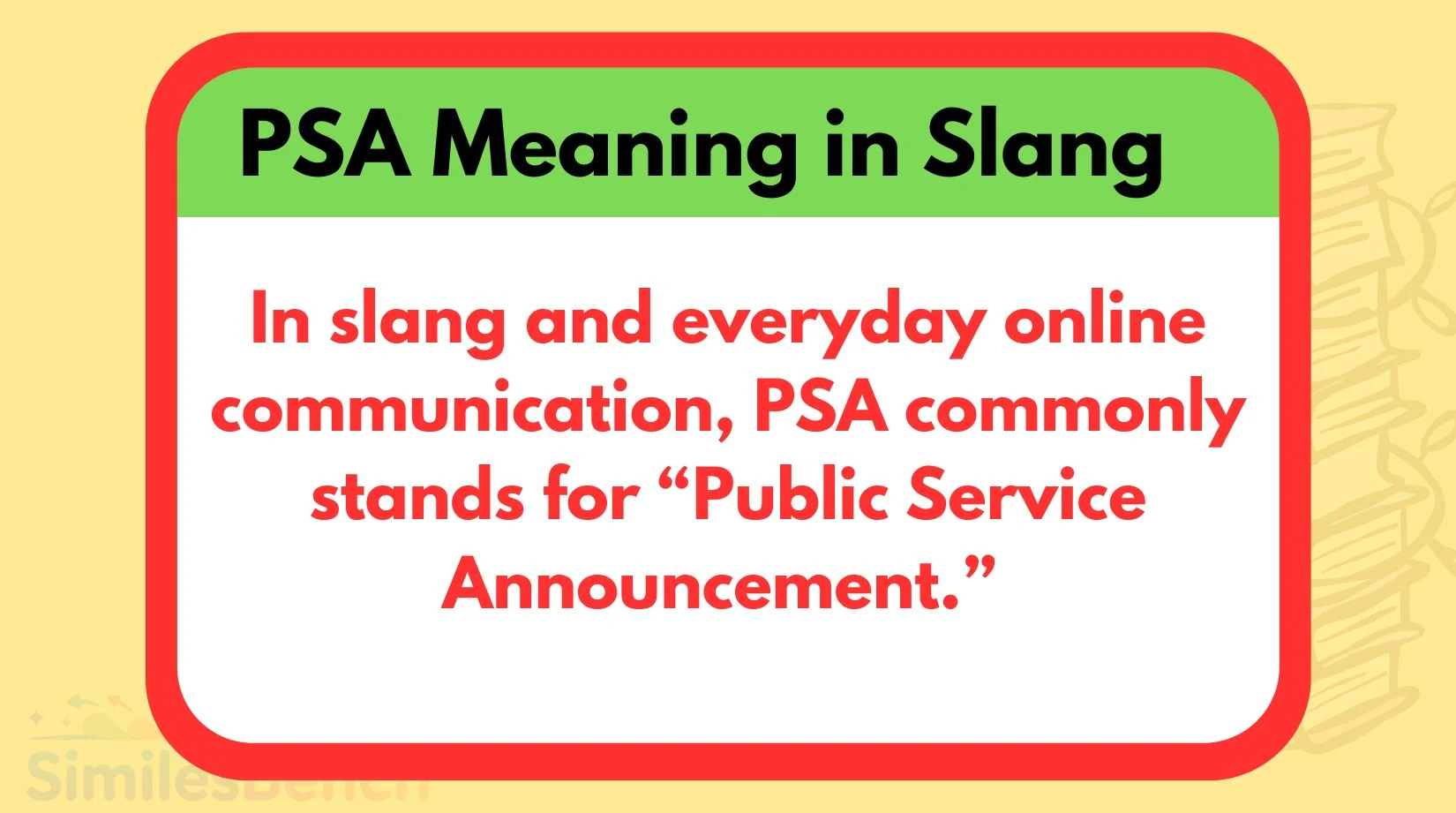
In slang and everyday online communication, PSA commonly stands for “Public Service Announcement.” Traditionally, this phrase refers to an important message shared with the public to inform or warn people about something.
However, in slang usage, the meaning becomes slightly different. Instead of a formal announcement from authorities or organizations, people use PSA to introduce a statement that they believe others should know. It often signals that someone is about to share helpful advice, a reminder, or an opinion that they think is important.
For example, someone might write:
- “PSA: Drink more water today.”
- “PSA: Don’t trust every deal you see online.”
In these cases, the speaker is not making an official announcement but is simply highlighting a message they want others to notice.
The tone can vary depending on context. Sometimes it is sincere and informative, while other times it is humorous or sarcastic. For instance, someone might jokingly say:
- “PSA: Mondays should be illegal.”
Here, the speaker is not providing real information but using the term playfully to emphasize a relatable statement.
Because of this flexible usage, PSA has become a popular shorthand online. It allows users to quickly signal that the message following it is meant for a broader audience rather than just one individual.
Overall, the slang meaning of PSA can be summarized as a quick announcement, tip, warning, or opinion shared publicly in a casual way.
Background & History
The phrase Public Service Announcement existed long before internet slang appeared. Historically, PSAs were messages broadcast on television, radio, or public platforms to educate people about important issues.
Government agencies, nonprofit organizations, and public institutions frequently used these announcements to spread awareness about topics such as health, safety, and community responsibilities.
Examples included messages encouraging people to wear seat belts, avoid smoking, conserve energy, or stay alert during emergencies. These announcements were usually serious and informational.
As digital communication grew, the abbreviation PSA began appearing in online forums and early internet communities. Users adopted the term as a convenient way to introduce useful information or advice.
Over time, the meaning expanded beyond its original formal use. Social media platforms accelerated this shift. People began using PSA in posts, memes, and tweets to highlight thoughts or observations.
This transformation reflects a common pattern in language evolution. Words and phrases often move from formal contexts into everyday conversation where they become more flexible and expressive.
Today, PSA is widely recognized in texting, social media, blogs, and online discussions. While its original meaning remains intact, the modern slang usage has made it far more casual and creative.
Usage in Various Contexts
PSA can appear in many different types of communication, especially in digital spaces. The meaning usually remains similar, but the tone changes depending on the situation.
1. Social Media Posts
On platforms like Twitter, Instagram, or Facebook, people often begin posts with PSA to highlight a message.
Example:
“PSA: Always double-check your emails before sending them.”
This helps draw attention and makes the post feel like an announcement.
2. Online Communities
In forums or discussion groups, users may share advice or helpful tips using PSA.
Example:
“PSA: This website has changed its password policy.”
Here, the message helps inform other community members.
3. Humor and Memes
Internet culture frequently uses PSA in a playful or exaggerated way.
Example:
“PSA: Pizza is acceptable for breakfast.”
These posts are usually meant for humor rather than serious guidance.
4. Warning Messages
Sometimes PSA introduces cautionary information.
Example:
“PSA: Be careful of scam messages pretending to be customer support.”
In this case, the term signals that the information could help others avoid problems.
Because of its versatility, PSA works as a quick signal that the following message is important, interesting, or worth noticing.
Common Misconceptions & Clarifications
Although PSA is widely used online, some misunderstandings still exist about its meaning.
One common misconception is that PSA always refers to official announcements. While this was true in traditional media, slang usage is much more casual.
Another misunderstanding is that PSA must contain serious information. In reality, many people use it jokingly or sarcastically.
Some users also assume PSA is directed at specific individuals. However, it typically addresses a general audience, not one person.
Additionally, some readers believe PSA implies authority or expertise. In most online situations, the person sharing the message is simply expressing an opinion or suggestion.
Understanding these clarifications helps interpret the tone of a message correctly and prevents confusion.
Similar Terms & Alternatives
Several other expressions serve a similar purpose to PSA when people want to share information or advice publicly.
Common alternatives include:
- FYI (For Your Information)
- Reminder
- Heads up
- Announcement
- Quick tip
- Note
Each of these phrases introduces useful or noteworthy information. However, PSA often feels more attention-grabbing because it mimics the style of formal announcements.
For example:
“FYI: The meeting time changed.”
Compared with:
“PSA: The meeting time has changed.”
The second version may sound slightly more dramatic or noticeable.
How to Respond to This Term
When someone uses PSA in a message or post, responding is usually simple. The appropriate reaction depends on the content of the announcement.
If the message contains helpful advice, you might respond with appreciation or agreement.
Examples:
- “Thanks for the reminder.”
- “Good tip.”
If the PSA is humorous, responding with laughter or a playful comment is common.
Examples:
- “Completely agree.”
- “That’s so true.”
If it contains a warning or serious information, acknowledging the message politely is appropriate.
Examples:
- “Thanks for sharing.”
- “That’s useful to know.”
Because PSA posts often aim to help or entertain others, positive engagement is typically welcomed.
Regional or Cultural Differences
The abbreviation PSA is widely understood in English-speaking online communities, but familiarity may vary across regions and cultures.
In countries where English slang dominates social media, the term is commonly recognized. Younger internet users, especially those active on social platforms, usually understand it instantly.
However, in regions where English is not the primary language, people may interpret PSA differently or be unfamiliar with the abbreviation.
Cultural communication styles also influence how often it is used. Some online communities enjoy dramatic or humorous announcements, while others prefer more direct messaging.
Despite these differences, the internet has helped standardize many slang terms, including PSA, across global audiences.
Comparison with Similar Terms
PSA vs FYI
- PSA highlights an announcement for a broader audience.
- FYI simply shares information without implying importance.
PSA vs Reminder
- PSA introduces new advice or awareness.
- Reminder assumes people already know the information.
- PSA feels more public and attention-grabbing.
- Heads up is often directed to specific individuals.
These distinctions explain why people choose PSA when they want their message to feel more like an announcement.
Usage in Online Communities & Dating Apps
PSA appears frequently in digital communities where people share advice, experiences, or opinions.
In discussion forums, users may post PSAs about technical tips, safety warnings, or helpful resources.
On dating apps or relationship discussions, the term can introduce observations about dating behavior.
Examples might include:
“PSA: Always verify profiles before meeting someone.”
These statements are usually meant to protect others or share personal experiences.
Because dating platforms involve communication with strangers, many users post PSAs to raise awareness about safety or etiquette.
Hidden or Offensive Meanings
In most cases, PSA is harmless and neutral. It does not usually carry offensive meanings.
However, the tone of the message following it can change how it is perceived. If someone uses PSA to criticize or mock others, it might appear sarcastic or passive-aggressive.
For example:
“PSA: Being rude doesn’t make you interesting.”
Although still an announcement, the tone may sound confrontational.
Therefore, the impact of a PSA depends more on the message itself than on the abbreviation.
Suitability for Professional Communication
PSA is generally informal and best suited for casual conversations, social media, or online communities.
In professional settings, more formal language is usually preferred. Instead of writing PSA in business emails or official documents, phrases such as “Important notice” or “Announcement” may be more appropriate.
However, in internal team chats or relaxed workplace communication channels, using PSA occasionally may be acceptable.
Understanding the context and audience helps determine whether this abbreviation is suitable.
FAQs
What does PSA mean in slang?
In slang, PSA usually means “Public Service Announcement,” used to share advice, reminders, or opinions with a general audience.
Is PSA always serious?
No. Many people use it humorously or sarcastically online.
Where is PSA commonly used?
It appears in social media posts, forums, group chats, and online communities.
Is PSA rude or offensive?
The abbreviation itself is neutral, but the message following it may change the tone.
Can PSA be used in professional communication?
It is generally informal, so formal alternatives are often preferred in professional settings.
Conclusion
The slang term PSA has evolved from a traditional phrase used in public broadcasting into a popular abbreviation across the internet. While it originally referred to official public service announcements, modern usage is far more casual and flexible.
Today, people use PSA to introduce tips, reminders, opinions, warnings, or humorous observations in online conversations. Its simplicity and attention-grabbing format make it ideal for social media and digital communities.
Although the abbreviation is generally harmless and widely understood, context plays an important role in determining how it is perceived. Whether used seriously or playfully, PSA remains a convenient way to highlight information meant for a broad audience.
By understanding its meaning, history, and usage, readers can better interpret online messages and participate confidently in modern digital communication.