Similes make writing come alive. They help readers see and feel what is happening, not just understand it. When we talk about falling—whether it’s falling down, falling asleep, or falling in love—similes turn a simple idea into something colorful and memorable.
In this guide, you’ll learn easy, creative similes for falling that students and writers can use with confidence and joy.
What Is a Simile?
A simile compares two things using the words “like” or “as.”
It helps readers imagine something more clearly.
Similes are often used in stories, poems, and everyday writing.
Full List of Similes for Falling
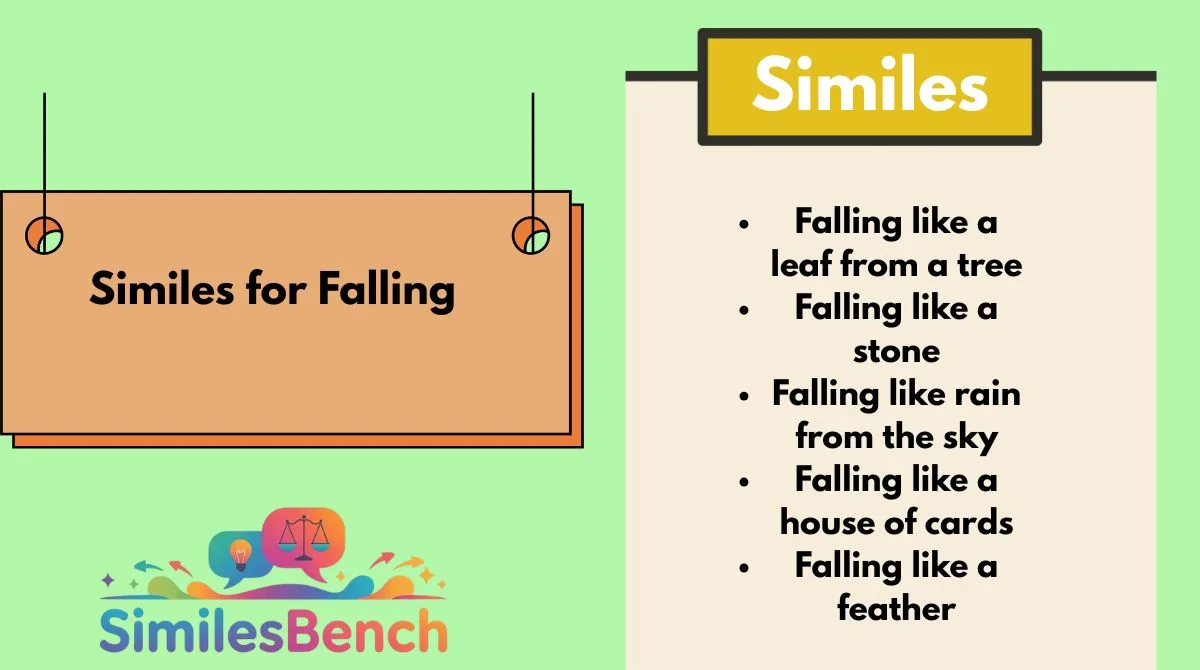
- Falling like a leaf from a tree
- Falling like a stone
- Falling like rain from the sky
- Falling like a house of cards
- Falling like a feather
- Falling like a shooting star
- Falling like a domino
- Falling like sand through fingers
- Falling like a dropped glass
- Falling like snow on a quiet night
- Falling like a tired soldier
- Falling like a broken kite
- Falling like a sack of potatoes
- Falling like a wave crashing
- Falling like a shadow at sunset
- Falling like a loose button
- Falling like a bird with wet wings
- Falling like a curtain at the end of a show
1. Falling like a leaf from a tree
Meaning: Falling slowly and gently
Explanation: This simile shows a soft, calm fall.
Examples:
She slipped on the grass and went down like a leaf from a tree.
The old paper drifted from his hand, falling like a leaf in autumn air.
2. Falling like a stone
Meaning: Falling fast and hard
Explanation: This compares a sudden drop to a heavy object.
Examples:
He missed the step and fell like a stone onto the floor.
The silence fell like a stone after the bad news.
3. Falling like rain from the sky
Meaning: Falling in large numbers or often
Explanation: Used when many things fall at once.
Examples:
Tears were falling like rain from the sky during the goodbye.
Leaves kept falling like rain all afternoon.
4. Falling like a house of cards
Meaning: Falling apart easily
Explanation: Shows how something weak collapses fast.
Examples:
His plan fell like a house of cards when one detail failed.
The tower of boxes fell like a house of cards.
5. Falling like a feather
Meaning: Falling lightly and softly
Explanation: A gentle and quiet fall.
Examples:
The scarf slipped from her shoulder, falling like a feather.
Snowflakes were falling like feathers in the night.
6. Falling like a shooting star
Meaning: Falling quickly and beautifully
Explanation: Often used for dramatic moments.
Examples:
He leapt and fell like a shooting star across the stage.
Her hopes rose high before falling like a shooting star.
7. Falling like a domino
Meaning: One fall causing another
Explanation: Shows a chain reaction.
Examples:
One runner tripped, and the rest fell like dominos.
When one lie was found, the rest fell like a domino line.
8. Falling like sand through fingers
Meaning: Slipping away slowly
Explanation: Often used for time or chances.
Examples:
His confidence was falling like sand through fingers.
The summer days felt like they were falling away the same way.
9. Falling like a dropped glass
Meaning: Sudden and sharp fall
Explanation: Suggests danger or surprise.
Examples:
She lost her balance, falling like a dropped glass.
The quiet moment shattered, falling like a dropped glass.
10. Falling like snow on a quiet night
Meaning: Falling peacefully
Explanation: Calm and soft feeling.
Examples:
Sleep came falling like snow on a quiet night.
Her worries eased, falling away the same gentle way.
11. Falling like a tired soldier
Meaning: Falling from exhaustion
Explanation: Shows deep tiredness.
Examples:
After the long race, he fell like a tired soldier.
She dropped onto the bed, falling like a tired soldier at rest.
12. Falling like a broken kite
Meaning: Losing control while falling
Explanation: Often emotional or physical.
Examples:
His dreams fell like a broken kite in the wind.
The toy spun and fell like a broken kite.
13. Falling like a sack of potatoes
Meaning: Heavy and clumsy fall
Explanation: Used humorously or seriously.
Examples:
He slipped on ice and fell like a sack of potatoes.
The bag dropped off the truck the same way.
14. Falling like a wave crashing
Meaning: Powerful and overwhelming fall
Explanation: Strong emotions or actions.
Examples:
Fear fell over her like a wave crashing.
He stumbled forward, falling with force and noise.
15. Falling like a shadow at sunset
Meaning: Falling slowly and quietly
Explanation: Gentle and natural change.
Examples:
Darkness fell like a shadow at sunset.
Sleep followed soon after, just as softly.
16. Falling like a loose button
Meaning: Unexpected small fall
Explanation: Quick and surprising.
Examples:
The coin slipped from his pocket, falling like a loose button.
Her smile dropped suddenly the same way.
17. Falling like a bird with wet wings
Meaning: Falling while struggling
Explanation: Shows effort and loss of control.
Examples:
He tried to stay upright, falling like a bird with wet wings.
Her voice broke, falling the same helpless way.
18. Falling like a curtain at the end of a show
Meaning: A clear ending
Explanation: Used for moments that finish something.
Examples:
Silence fell like a curtain at the end of a show.
The day ended, falling away clean and final.
Creative Writing Tips
Similes are powerful tools when used with care. In stories, use them to show emotions instead of naming them. In poems, keep similes simple so the feeling stays strong. For essays, choose similes that match your topic and tone. In songs, use smooth, easy images people can picture quickly. One strong simile is better than many weak ones. Let your words breathe.
FAQs
What is a simile for falling?
A simile for falling compares falling to something else using “like” or “as,” such as falling like a leaf.
Why do writers use similes?
Writers use similes to make ideas clearer, more colorful, and more emotional.
Can similes describe feelings too?
Yes. Similes often describe emotions like fear, love, or sadness.
Are similes okay for school essays?
Yes. When used correctly, they can make writing stronger and more interesting.
What’s the difference between a simile and a metaphor?
A simile uses “like” or “as.” A metaphor does not.
Conclusion
Similes turn simple moments into powerful images. When you learn how to use them, your writing becomes clearer and more expressive. These similes for falling can help you describe action, emotion, and change with ease. Try a few in your next story or essay. With practice, your words will fall into place naturally and confidently.