In today’s fast-moving digital world, slang evolves quickly, and short forms like “PDA” often leave people curious. You might have seen it in text messages, social media captions, or dating profiles and wondered what it actually means. The phrase “PDA meaning slang” is commonly searched because it can carry different interpretations depending on context.
Most often, PDA stands for “Public Display of Affection,” but its tone, intent, and appropriateness can vary widely. People want to understand whether it’s romantic, awkward, acceptable, or even inappropriate in certain situations. With online communication becoming more expressive and informal, knowing how and when to use such slang is important.
This article breaks down the meaning, origin, usage, and nuances of PDA in slang, helping you understand it clearly and use it confidently without confusion or misinterpretation.
Definition & Meaning
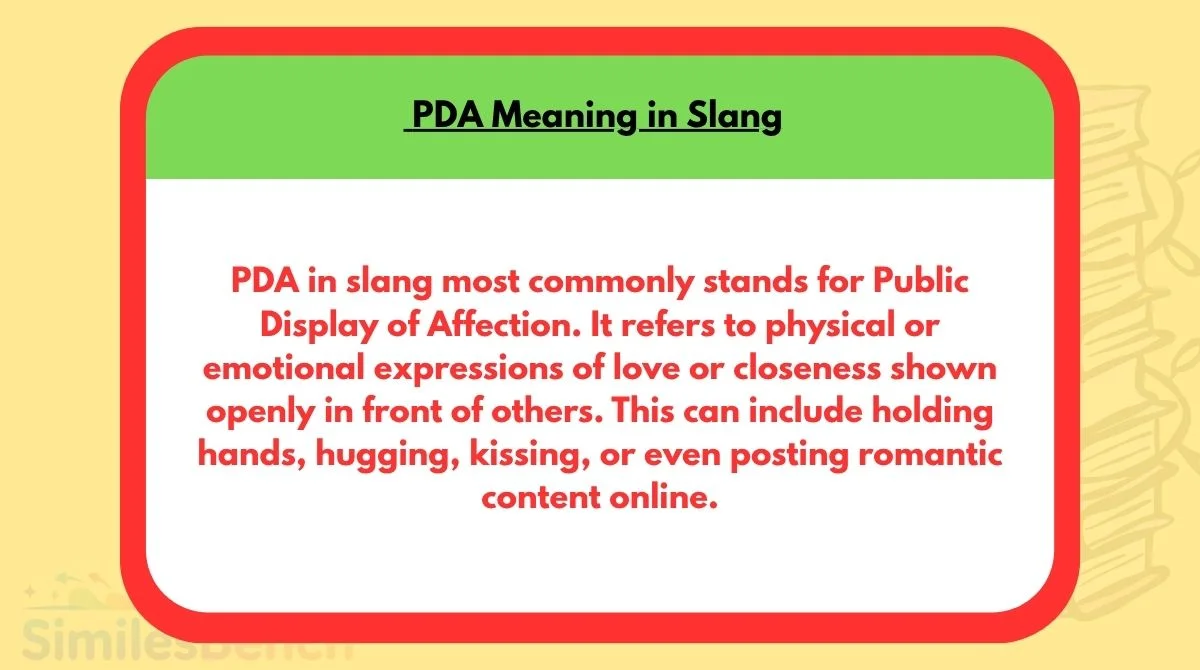
PDA in slang most commonly stands for Public Display of Affection. It refers to physical or emotional expressions of love or closeness shown openly in front of others. This can include holding hands, hugging, kissing, or even posting romantic content online.
In casual conversation, when someone says, “That was too much PDA,” they usually mean that a couple was being overly affectionate in public. On the other hand, “I love a little PDA” suggests comfort with mild expressions of affection.
Interestingly, the slang meaning extends beyond physical interaction. In the digital age, PDA can also describe posting romantic photos, couple selfies, or affectionate captions on social media. For example, frequent love posts might be labeled as “online PDA.”
Tone matters a lot. PDA can be used positively (cute, romantic) or negatively (awkward, excessive). The meaning depends on personal boundaries, cultural norms, and context.
Overall, PDA is a flexible slang term used to describe how openly people express affection, both offline and online.
Background & History
The concept of PDA existed long before the slang became popular. Public expressions of affection have always been part of human relationships, but attitudes toward them have shifted over time.
Historically, many societies discouraged visible displays of intimacy, especially in conservative cultures. Couples were expected to maintain privacy in their relationships. However, as societies modernized, especially in Western regions, public affection became more accepted.
The abbreviation “PDA” gained popularity in the late 20th century as communication became more informal. With the rise of texting and internet chatrooms, people began shortening phrases for convenience. “Public Display of Affection” was quickly condensed into “PDA,” making it easier to use in everyday conversation.
Social media played a major role in expanding its meaning. Platforms like Instagram and Snapchat introduced a new form of PDA—digital affection. Posting romantic gestures online blurred the line between private and public spaces.
Today, PDA is widely recognized across different age groups, especially among younger generations who frequently use slang in communication.
Usage in Various Contexts
PDA is used in different situations depending on the setting and medium of communication.
In real life, it refers to visible affection between people in public spaces such as parks, malls, or restaurants. Someone might comment on a couple hugging or kissing and describe it as PDA.
In texting and chats, PDA is often used humorously or critically. For example, “No PDA please!” might be said jokingly in a group conversation when two people act overly romantic.
On social media, PDA has expanded into posting behavior. Sharing love notes, anniversary posts, or couple selfies can all be labeled as PDA. Sometimes people even call it “social media PDA” when it feels excessive.
In relationships, PDA can also be a topic of discussion. Some partners are comfortable with public affection, while others prefer privacy. This makes PDA not just a slang term but also a reflection of personal boundaries.
Overall, its usage depends on context—offline interactions, online behavior, or relationship dynamics.
Common Misconceptions & Clarifications
One common misconception is that PDA always means something inappropriate. In reality, it simply refers to public affection, which can be mild or intense. Holding hands is just as much PDA as kissing, but the level of comfort differs.
Another misunderstanding is that PDA is only physical. In modern slang, emotional expressions shared publicly—like romantic posts—also count.
Some people assume PDA is universally accepted or rejected, but that’s not true. Acceptance varies widely depending on culture, environment, and personal values. What feels normal in one place may feel uncomfortable in another.
There is also confusion between PDA and attention-seeking behavior. While some people use public affection to gain attention, not all PDA is done for that reason. Often, it’s just a natural expression of feelings.
Clarifying these misconceptions helps people understand the term more accurately and avoid unnecessary judgment or awkward situations.
Similar Terms & Alternatives
Several slang terms and phrases relate to PDA or express similar ideas.
“Lovey-dovey” describes overly affectionate behavior, often in a playful or slightly teasing tone. “Affectionate” is a more neutral and formal alternative. “Touchy” can sometimes be used, though it may carry a slightly negative meaning.
In online spaces, phrases like “couple goals” or “relationship goals” are often linked with PDA, especially when people admire public displays of love.
“Soft launch” is another modern term related to relationships. It refers to subtly introducing a partner online without obvious PDA.
Each of these alternatives carries its own tone, from playful to critical to admiring. Choosing the right term depends on how you want to describe the situation.
How to Respond to This Term
When someone uses PDA in conversation, your response should match the tone and context.
If it’s used jokingly, you can respond playfully. For example, “Okay, we’ll tone down the PDA!” keeps the conversation light.
If someone criticizes PDA, it’s best to respect their perspective. A simple response like “Fair enough, everyone has their comfort level” works well.
In conversations about relationships, PDA can open discussions about boundaries. Responding honestly about your comfort level helps avoid misunderstandings.
If you’re unsure about the meaning in a specific context, asking for clarification is always acceptable. Slang can vary, and it’s better to confirm than assume.
The key is to stay respectful and aware of different comfort zones.
Regional or Cultural Differences
PDA is perceived very differently across cultures.
In many Western countries, mild PDA like holding hands or hugging is widely accepted. In contrast, in more conservative regions, including parts of South Asia and the Middle East, public affection may be discouraged or considered inappropriate.
Even within the same country, urban areas tend to be more accepting than rural ones. Social norms, religious beliefs, and generational differences all influence attitudes toward PDA.
Online PDA, however, is more globally accepted, though still subject to personal and cultural preferences.
Understanding these differences is important, especially when traveling or interacting with people from diverse backgrounds.
Comparison with Similar Terms
PDA is often compared with terms like romance, intimacy, and affection, but there are subtle differences.
Romance is a broader concept that includes emotional connection and gestures, while PDA specifically refers to public expression. Intimacy is deeper and more private, not necessarily visible to others.
Affection is a general term that includes both private and public expressions, making PDA a subset of affection.
Compared to these terms, PDA is more situational. It focuses on where and how affection is shown rather than the feeling itself.
This distinction helps people use the term more accurately and avoid confusion.
Usage in Online Communities & Dating Apps
In online communities and dating apps, PDA has taken on a slightly expanded meaning.
People often mention PDA preferences in dating profiles. For example, someone might say they enjoy “a little PDA,” indicating comfort with public affection. Others might clearly state they prefer minimal PDA.
On platforms like Instagram, frequent couple posts are often labeled as PDA. Some users appreciate it, while others find it excessive.
In online discussions, PDA can also become a topic of debate, with people sharing opinions about what’s acceptable or not.
Overall, digital spaces have made PDA more visible and more open to interpretation than ever before.
Hidden or Offensive Meanings
PDA itself is not inherently offensive, but its usage can become negative depending on tone.
When used sarcastically, it can imply that someone is being overly dramatic or attention-seeking. For example, “We get it, enough PDA” might carry a critical tone.
In some contexts, calling out PDA publicly can embarrass people, especially if they didn’t intend to draw attention.
There are no major hidden meanings, but like any slang, it can be used to judge or tease. Being mindful of tone helps avoid misunderstandings.
Suitability for Professional Communication
PDA is generally considered informal slang and is not suitable for professional or formal communication.
In workplace settings, it’s better to use phrases like “public behavior” or “professional boundaries” instead of slang.
Using PDA in casual office conversations may be acceptable among colleagues, but it should be avoided in emails, reports, or official discussions.
Maintaining professionalism means choosing clear and neutral language rather than slang abbreviations.
FAQs
What does PDA mean in texting?
It usually means Public Display of Affection.
Is PDA always romantic?
Mostly yes, but it can also include friendly affection.
Is PDA considered inappropriate?
Depends on culture and situation.
Can PDA happen online?
Yes, through posts, captions, and photos.
Why do people dislike PDA?
It can feel uncomfortable or excessive.
Is PDA okay in relationships?
It depends on mutual comfort levels.
Conclusion
PDA is a widely used slang term that primarily refers to public expressions of affection, both offline and online. While simple in definition, its interpretation depends heavily on context, culture, and personal preferences.
Understanding its meaning helps you navigate conversations, relationships, and social situations more effectively. Whether seen as romantic or excessive, PDA ultimately reflects how openly people choose to express their emotions.